NMMC Debris Portal
A construction and demolition debris portal for Navi Mumbai Municipal Corporation: truck checks, dumping reports, cases, fines and a live map of trucks.
Client
Navi Mumbai Municipal Corporation (NMMC)
Services
Web App Development, Government Solutions
Industries
Government, Public Sector
Date
June 2026
Challenge
Making sure construction and demolition debris in Navi Mumbai ends up at an authorised processing plant, not on a roadside, on an empty plot or in the mangroves.
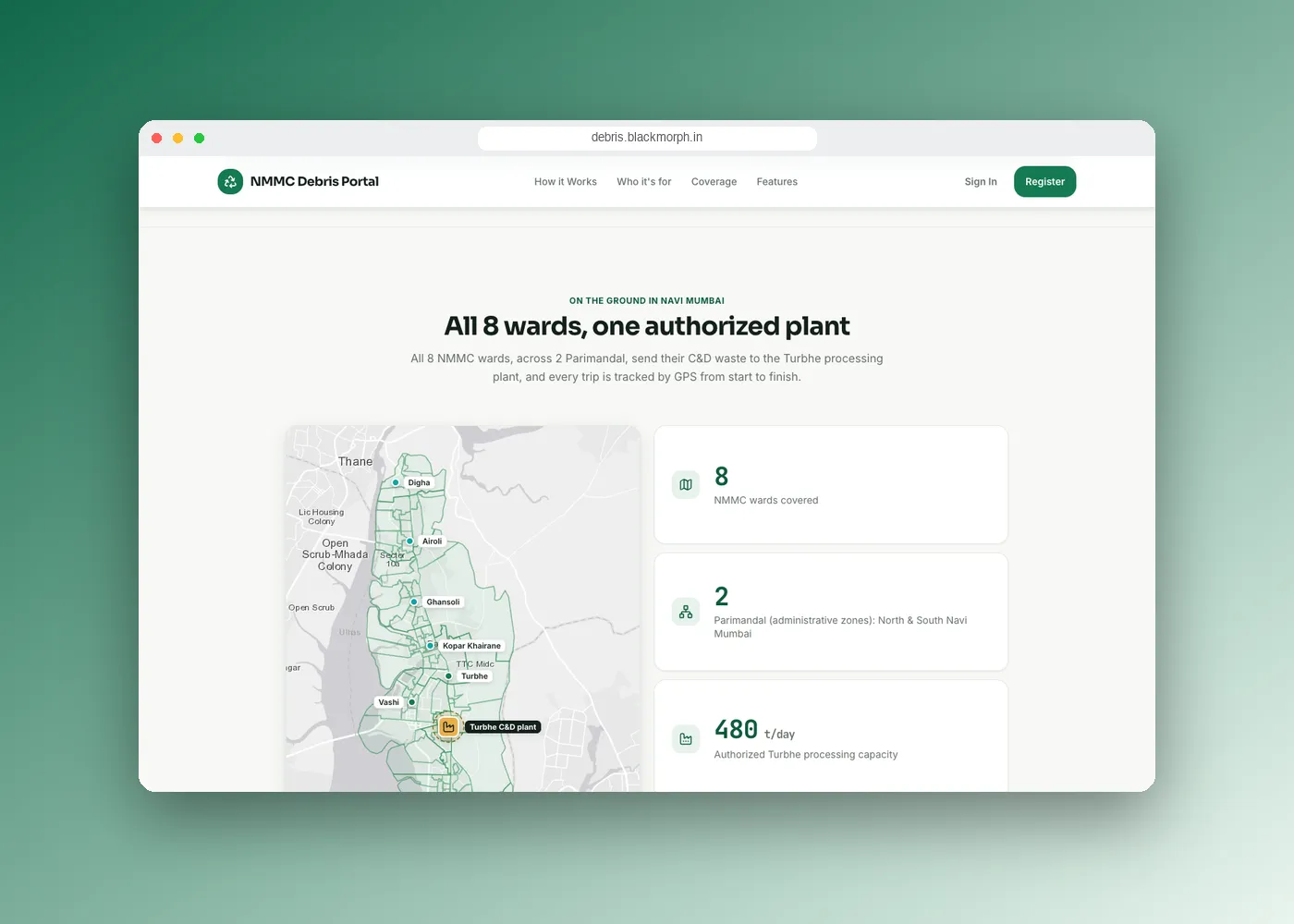
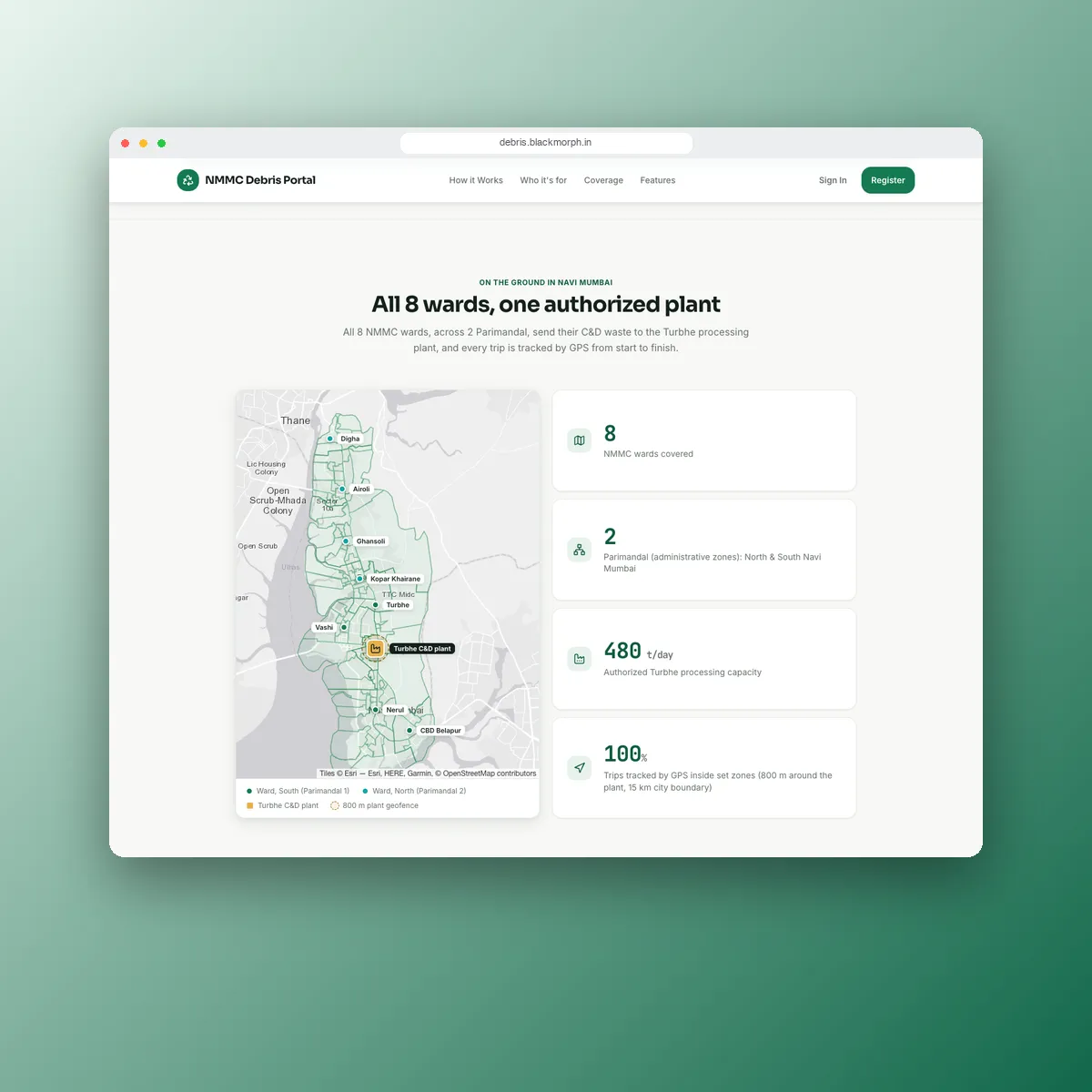
Navi Mumbai Municipal Corporation regulates how construction and demolition (C&D) waste is collected, carried and processed across its eight wards. Citizens, housing societies, builders, transporters, contractors, recyclers and NMMC officials all take part, and its Debris Squad works in the field like traffic police for debris trucks. Officers needed to know on the spot whether a truck is registered and on a genuine job. They also needed to record illegal dumping with evidence, and to follow each violation through to a fine that is paid, appealed or waived.
Approach
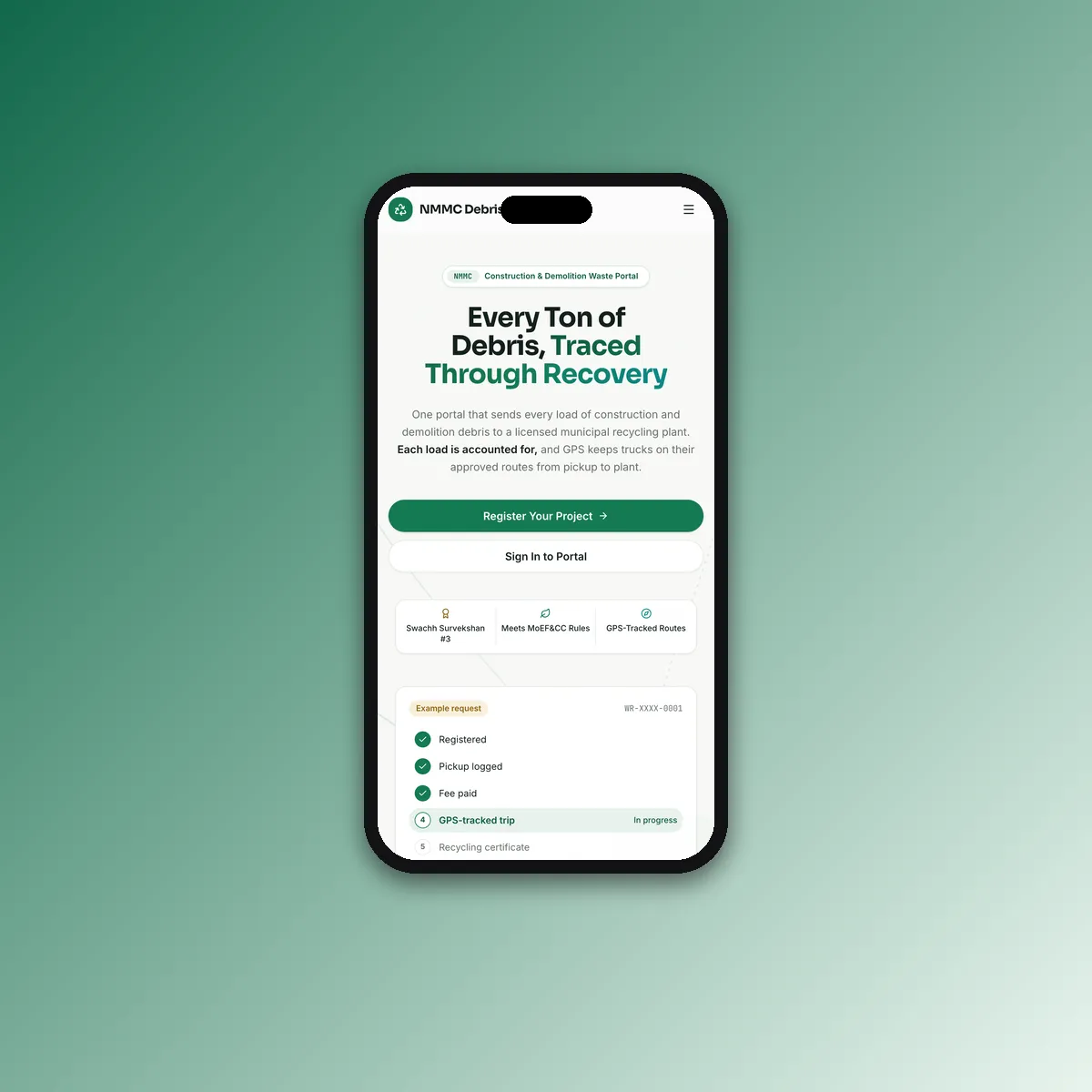
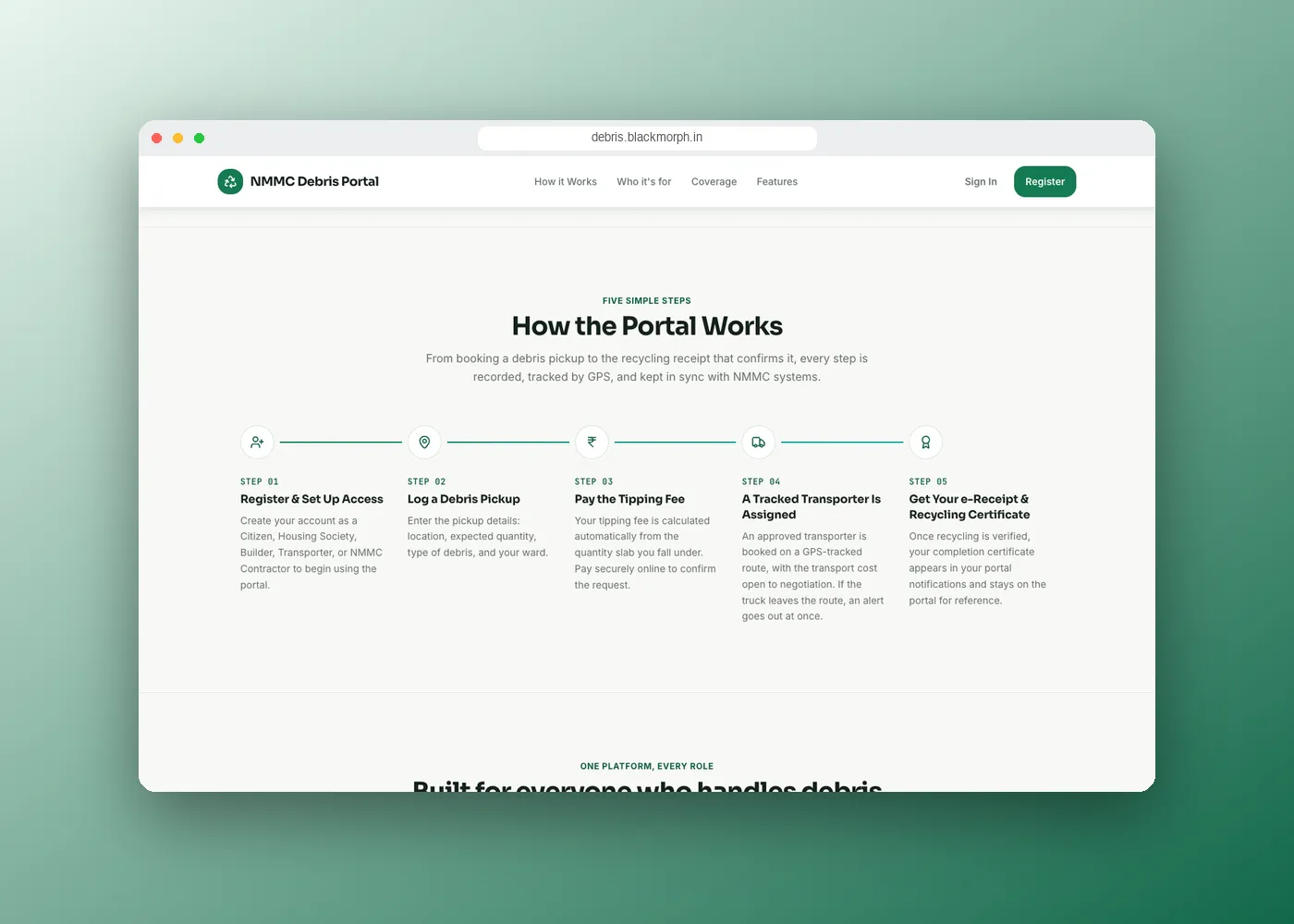
We built one portal with a separate sign-up and dashboard for each group. Citizens and housing societies book debris pickups, builders register projects, and transporters pick jobs from a job board and make GPS-tracked trips. Recyclers record the weight of each delivery, and NMMC officials approve requests and act on violations. Each role sees only the screens and records that belong to it, and ward officers see their own ward.
For the Debris Squad we kept the field tools short and direct. Track Vehicle answers two questions from a number plate; Report Dumping takes a photo, a pin on the map and a short note, and works out the ward on its own. Every violation becomes a case that moves through fixed stages, from opened and under investigation to notice issued, appealed or upheld, and recovered, with the evidence attached at each step.
Solution
The portal is a Next.js 16 and React 19 application with an Appwrite backend for the database, accounts and file storage, and Leaflet maps for trucks, routes and violation spots. When a squad member signs in, the dashboard shows a live map of trucks from their GPS trackers and the open cases. It also shows automatic GPS alerts, pending fines and the cases reported that day.
Scheduled functions on the server do the work nobody should have to remember. If a truck on an active job leaves its permitted area, every ward officer and squad member is alerted. They can waive the alert with a reason, such as maintenance or a puncture; if nobody reviews it within 48 hours, the fine set by NMMC is applied automatically. The portal is packaged as a Docker container for deployment.
Key
features
Truck check by number plate. An officer types a number plate and sees whether the truck is registered and approved, and whether it is on a debris job right now.
Report dumping. Illegal dumping is filed with a photo, a pin on the map, a short note and the truck number if it was seen; the ward is worked out automatically.
Cases with an evidence trail. Every violation is a case with photos, videos, documents and notes attached, moving through clear stages from opened to resolved.
Fines: paid, appealed or waived. Each fine has an amount, notice date and payment deadline; operators can appeal once, and NMMC waives or upholds it.
Live map of trucks and violations. Truck locations from their GPS trackers and reported violation spots are shown together on one city map.
GPS area alerts with a review window. A truck leaving its permitted area during a job raises an alert for officers to review before any automatic fine is applied.
Tech
stack
- Next.js 16
- React 19
- TypeScript
- Tailwind CSS 4
- Appwrite
- Leaflet
- Motion
- React Compiler
- Docker
- Biome
Results
Debris Squad officers can check any debris truck on the road from its number plate and see at once whether it needs to be stopped.
Illegal dumping is reported from the spot with a photo and map location, and lands in the right ward without anyone sorting it.
Every case and fine has a recorded, step-by-step history, so decisions can be explained and defended later.
Trucks that leave their permitted area are flagged even when no officer is watching, and still get a fair review before a fine.
Related
The service, sector and guides behind this project.
Portals and internal systems for government departments: role-based access, audit logging, SLA tracking and reporting dashboards.
 Transform your vision into reality
